

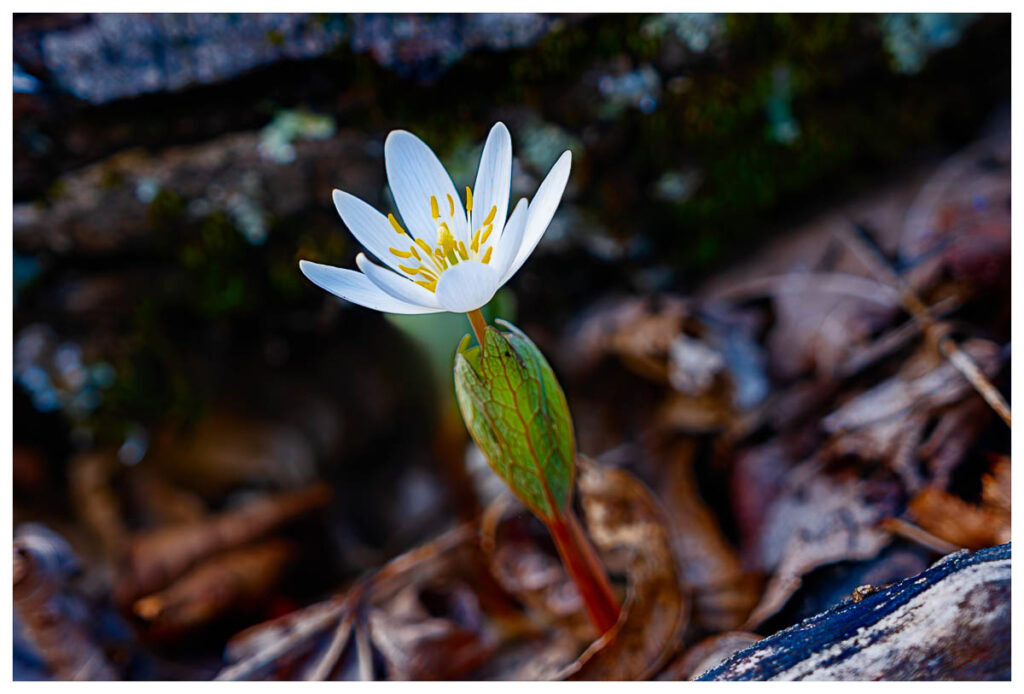
Bloodroot (Sanguinaria canadensis) is one of the earliest wildflowers to appear on the eastern North American forest floor each spring. Its white petals last only a day or two, its orange-red sap has a centuries-long history of use — and a well-documented record of danger. Here is what you need to know before you go looking for it.
Bloodroot (Sanguinaria canadensis): A Spring Wildflower Gallery

No more pages to load
For those of us in Central New York, spring does not arrive on the calendar — it arrives on the forest floor. Among the earliest signs is a pure white flower barely rising above the dead leaf litter, here for two days and gone before most people have thought to look. That is Bloodroot (Sanguinaria canadensis), and if you have hiked the woods near Warners or around the Finger Lakes in early April, you have almost certainly walked past it without knowing what you almost stepped on.
The name is not decorative. Snap the thick underground rhizome or break a leaf stalk and the plant bleeds — a bright, acrid, orange-red sap that has been used as a dye, a medicine, and, in modern consumer products, an ingredient now withdrawn from the North American market after being linked to precancerous oral lesions. For a flower that disappears within 48 hours of opening, it carries a considerable amount of history.
A True American Native
Bloodroot is a perennial herbaceous flowering plant native to eastern North America. Its range extends from Nova Scotia and Manitoba in the north, south to Florida, and west to the edge of the eastern deciduous forest — roughly to Nebraska and Arkansas, not the open Great Plains as sometimes stated. It is native to every state in the eastern half of the country and is a foundational species of Appalachian and Great Lakes woodland ecosystems.
It is also worth knowing its legal status locally: Bloodroot is classified as Exploitably Vulnerable in New York State, meaning wild populations are under pressure from habitat loss and collection. That designation carries real weight for photographers. Observe it, photograph it, and leave it exactly where you found it.
(For a closer look at photographing another native wildflower under similar pressures, see the Grass Pink Orchid post for notes on ethical field practice.)
Growing Conditions: The Goldilocks of the Woods
Bloodroot is selective about its environment, which is why undisturbed woodland is consistently where you find it. It needs sunlight before the canopy closes in spring — full sun on the forest floor for a few weeks is essential for flowering — and once the trees leaf out, it tolerates and prefers deep shade. This timing is the key to finding it: look in gaps and edges where early light reaches the ground.
It favors rich, moist, well-drained soil with plenty of leaf mulch, and it is reliably hardy in Zones 3–8, well-matched to the temperature swings of Central New York winters. It tends to colonize in patches rather than spread widely, so once you locate one plant, look for others nearby — they are typically growing as a colony from shared rhizomes.
The Bloom: A One-Day Wonder
In Central New York, watch for Bloodroot from late March through mid-April, depending on the year and how quickly the soil warms. It is one of the earliest spring ephemerals on the calendar, and a late snow in April does not necessarily mean you have missed it entirely — the plant is surprisingly cold-tolerant at bloom time.
The flower is a striking, pure white with typically 8 petals arranged in two rows of four, occasionally more in wild specimens. The center is a dense cluster of bright yellow stamens. Individual flowers last only one to two days in sunny conditions. The plant does something unusual on the way up: a single deeply lobed, grayish-green leaf wraps around the flower stalk as it emerges from the ground, protecting the bud like a furled cloak. The leaf continues to unfurl as the flower opens and then expands to full size — sometimes 12 inches across — after the flower has already dropped its petals and vanished.
That leaf is your best field marker after the bloom has passed. The flowers disappear; the distinctive lobed leaf persists through summer before the plant goes fully dormant.
Why the Name “Bloodroot”
The genus name Sanguinaria derives from the Latin sanguinarius, meaning “bleeding.” The active compound responsible for the sap’s color and toxicity is sanguinarine, a benzophenanthridine alkaloid that kills animal cells by blocking the action of Na⁺/K⁺-ATPase transmembrane proteins — the ion pumps that regulate cellular function. When sanguinarine contacts living tissue, it disrupts this process, destroying cells and, if exposure is sustained or concentrated, causing tissue necrosis. The reddish-orange color of the sap itself comes from related alkaloids in the same biosynthetic pathway, including chelerythrine and berberine.
In Plain English: The plant produces a group of toxic compounds that essentially shut down the machinery of living cells. That is why the sap stains skin and, in sufficient concentration, destroys it.
The Ant Connection: A Survival Story
One of the most elegant things about Bloodroot is how it spreads. It relies on a process called myrmecochory — seed dispersal by ants. Each seed carries a small fleshy appendage called an elaiosome, which is rich in lipids and proteins. To an ant, it is food worth carrying home.
Ants transport the seeds to their nests, consume the elaiosome, and discard the seed in their underground waste chambers. Those chambers are rich in organic matter — effectively a pre-fertilized nursery bed. The seedling germinates in conditions it could not have reached on its own. This is a mutualistic relationship refined over millennia, and it is why Bloodroot tends to appear in established woodland rather than disturbed edges: it moves slowly, one ant colony at a time.
There is a conservation footnote here. Invasive ant species — particularly non-native fire ants where their range overlaps with Bloodroot — often damage seeds while consuming the elaiosome, or deposit them in unsuitable locations. The introduction of non-native ant species is one of the quieter threats to Bloodroot’s long-term spread.
Finding It in Central New York
Look in shaded, moist ravines, older woodlots, and north-facing slopes where spring comes a little later and the soil holds moisture. In the Warners area, Camillus Forest Unique Area and the wooded edges along the Erie Canal Trail are worth checking in the last week of March and first two weeks of April. Go early in the day when light is on the forest floor — the flowers close at night and on cloudy days, so a bright morning is your window.
Because the bloom lasts only one to two days per flower, timing matters more here than with almost any other spring subject. If you find the leaves but no flowers, you are either early (the bud may still be furled inside the leaf) or late (the petals have already dropped). Either way, mark the location — they will be back next year in exactly the same spot.
Native American Uses
Indigenous peoples across eastern North America used the sap of Bloodroot for centuries. As a dye, the pigment was applied to skin, clothing, and woven baskets — the color is intense and long-lasting. The sap also served as an insect repellent. Medicinally, groups including the Algonquin and Iroquois used it in small, carefully controlled doses for respiratory ailments and as a topical treatment for certain skin conditions. All of these uses exploited the same potent chemistry — the difference between therapeutic use and harm is, as with many plant medicines, a question of dose and form of application.
Modern Uses and Cautions
Sanguinarine’s antibacterial properties attracted commercial interest, and it was incorporated into toothpastes and mouthwashes to combat dental plaque. The most notable product was Viadent. It is no longer on the market. Viadent was withdrawn from sale in North America after research linked prolonged oral use of bloodroot-containing products to oral leukoplakia — a premalignant lesion that can progress to oral cancer. The FDA has also included bloodroot-derived products on its list of fake cancer treatments consumers should avoid.
This history matters because “natural” health products containing bloodroot sanguinarine extract — toothpastes, black salve, skin cancer treatments — continue to circulate online. Black salve, a topical preparation derived from bloodroot, is actively marketed as a home remedy for skin cancer. It is not. It burns tissue indiscriminately: visible tumor cells are destroyed, but microscopic deposits can remain, and documented case reports show tumor recurrence and metastasis following black salve application. The scarring it causes is permanent. The FDA classifies these products as unapproved drugs.
Bloodroot is a “look but don’t touch” plant — and not just because the sap stains.
FAQs
When does Bloodroot bloom in Central New York?
Late March through mid-April in most years. Individual flowers last only one to two days, so timing matters. Look for the distinctive lobed leaf if you miss the bloom.
Is Bloodroot safe to touch?
No. The orange-red sap contains sanguinarine, an alkaloid that destroys skin cells on contact and causes tissue necrosis with sustained exposure. Observe and photograph it without handling it.
Is Bloodroot protected in New York State?
Yes. New York classifies it as Exploitably Vulnerable, meaning wild populations are under documented pressure. Do not collect, dig, or remove plants or seeds from wild colonies.
How does Bloodroot spread through the forest?
Through myrmecochory — ants carry the seeds back to their nests to eat a fatty appendage called an elaiosome, then discard the seed in organic-rich underground chambers where it germinates.
References
- Mascarenhas, A.K., Allen, C.M., & Loudon, J. (2001). The association between Viadent use and oral leukoplakia. Epidemiology, 12(6), 741–743. https://pubmed.ncbi.nlm.nih.gov/11679804/
- Mascarenhas, A.K., Allen, C.M., & Moeschberger, M.L. (2002). The association between Viadent use and oral leukoplakia — results of a matched case-control study. Journal of Public Health Dentistry, 62(3), 158–162. https://pubmed.ncbi.nlm.nih.gov/12180043/
- Munro, I.C., Delzell, E.S., Nestmann, E.R., & Lynch, B.S. (1999). Viadent usage and oral leukoplakia: a spurious association. Regulatory Toxicology and Pharmacology, 30(3), 182–196. https://pubmed.ncbi.nlm.nih.gov/10620468/
- Eastman, K.L., McFarland, L.V., & Raugi, G.J. (2014). A review of topical corrosive black salve. Journal of Alternative and Complementary Medicine, 20(4), 284–289.
- Vlachojannis, C., Magora, F., & Chrubasik, S. (2012). Rise and fall of oral health products with Canadian bloodroot extract. Phytotherapy Research, 26, 1423–1426.
- U.S. Food and Drug Administration. “Do Not Use: Black Salve Is Dangerous and Called by Many Names.” Consumer Update, October 13, 2020. https://www.fda.gov/consumers/consumer-updates/do-not-use-black-salve-dangerous-and-called-many-names
- United Plant Savers. “Bloodroot — Sanguinaria canadensis.” https://unitedplantsavers.org/bloodroot-sanguinaria-canadensis-2/
- Lady Bird Johnson Wildflower Center, University of Texas at Austin. “Sanguinaria canadensis — Bloodroot.” Native Plants Database. https://www.wildflower.org/plants/result.php?id_plant=saca13
- Ohio State University News. “Dentists See Legacy of Discontinued Ingredients in Patients’ Mouths.” December 27, 2001. https://news.osu.edu/dentists-see-legacy-of-discontinued-ingredients-in-patients-mouths/
- Sivyer, G.W., & Rosendahl, C. (2014). Application of black salve to a thin melanoma that subsequently progressed to metastatic melanoma: a case study. Dermatology Practical & Conceptual, 4, 77–80.
- USDA PLANTS Database. “Sanguinaria canadensis L. — Bloodroot.” https://plants.usda.gov/plant-profile?symbol=SACA13
- PMC / National Library of Medicine. Serafin, A., et al. (2023). “Black Salve: A Dangerous Corrosive Disguised as an Alternative Medicine.” Cureus. https://pmc.ncbi.nlm.nih.gov/articles/PMC10388685/
- U.S. Food and Drug Administration. Warning Letter to McDaniel Water, LLC. September 7, 2021. https://www.fda.gov/inspections-compliance-enforcement-and-criminal-investigations/warning-letters/mcdaniel-water-llc-616186-09072021