


The Dryad’s Saddle (Cerioporus squamosus) is one of the first large fungi to appear each spring, growing directly from hardwood logs and stumps across the Northeast. It is identifiable by its pale, scaly cap, irregular pores, and distinctive mealy scent. Young specimens are edible. This post covers identification, host trees, fruiting season, and what the recent name change actually means including a photo gallery.
No more pages to load
What Is the Dryad’s Saddle?
The Dryad’s Saddle is a wood-decomposing bracket fungus widely distributed across the Northern Hemisphere. It has gone by Polyporus squamosus for most of recorded mycology, but DNA analysis confirmed that the Dryad’s Saddle and its close relatives are sufficiently distinct from true Polyporus species to warrant a separate genus — Cerioporus (Larsson & Pöder, 2003). Polyporus squamosus remains a widely used synonym and will appear throughout older field literature. Both names refer to the same organism.
It is saprobic — feeding on dead wood — and sometimes parasitic on weakened trees, where it causes white rot in the heartwood. It is not a soil mushroom. You will find it growing directly from logs, stumps, or the trunks of living but stressed hardwoods.
Geographic Range
The Dryad’s Saddle is broadly distributed across North America, Europe, and Asia, with occurrences also documented in parts of Australia. In the United States it is considered native and is especially prolific east of the Rocky Mountains (Kuo, 2007). The Midwest and Northeast offer some of the most consistent early-season fruiting, and the species has been documented across every northeastern state.
When to Look: Fruiting Season in the Northeast
In the Northeast United States, the Dryad’s Saddle is one of the first large mushrooms of the year.
Primary season: Late April through June. It frequently appears at the same time as morels, which is why foragers sometimes call it a consolation prize when morel populations are thin.
Secondary fruiting: Fruiting can continue into summer or fall under suitable conditions. Individual specimens are durable and can persist for weeks or longer in stable weather — though they become too tough to eat quickly after the first few days.
Timing matters more than location. Once you know where a productive log or stump is, the fungus will return to the same substrate year after year.
How to Identify the Dryad’s Saddle
The Cap
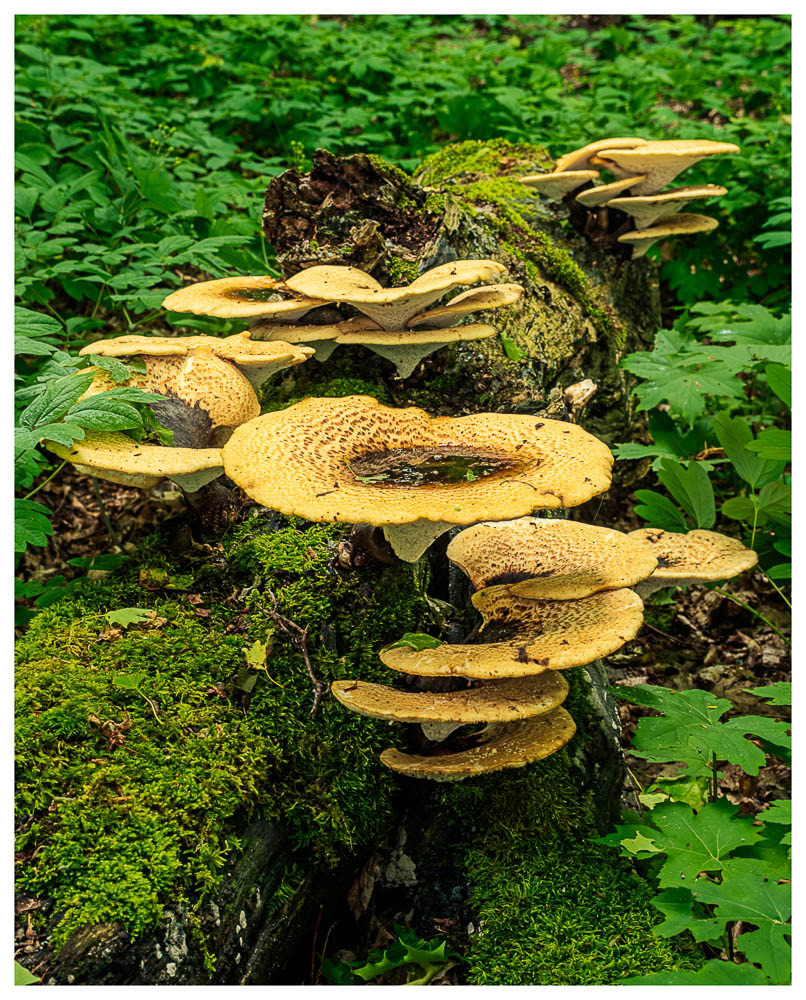
Fan- or saddle-shaped, typically 8–30 cm (3–12 in) across, with exceptional specimens documented at 60 cm (24 in) and up to 10 cm (4 in) thick (Kuo, 2007). The upper surface is pale yellow to cream with concentric rings of dark brownish scales — squamules — that produce the feathered pattern that gives the mushroom its second common name, Pheasant’s Back.
The Pores
There are no gills. The underside features large, angular, irregular pores — creamy white to pale yellow — that are characteristic of the genus. Do not expect a neat hexagonal grid; the pore structure is irregular.
The Stem
Thick, offset (eccentric), and typically dark brown to black at the base where it meets the wood.
The Scent
The odor is produced by a compound called trans-2-nonenal, the same aldehyde responsible for the characteristic scent of watermelon rind — and, at different concentrations, for the “old book” smell associated with aging paper. This is not coincidental: the compound is released as the polysaccharides in the fungal tissue and the underlying wood begin to break down. MushroomExpert describes the odor as “strongly mealy” (Kuo, 2007); informal foraging sources frequently compare it to watermelon rind. Both descriptions are accurate at different stages of freshness.
In Plain English: When you slice into a fresh Dryad’s Saddle, it releases a strong, distinctive smell that most people compare to watermelon rind or fresh flour. If you smell it and you have the right visual ID, you are almost certainly looking at the right mushroom.
Host Trees
Elm (Ulmus) is the most commonly cited host, but the Dryad’s Saddle grows on a wide range of hardwoods including maple, ash, beech, poplar, willow, and horse-chestnut.
Safety and Edibility
Status: Edible when young — with caveats.
The Dryad’s Saddle is non-toxic, but palatability depends almost entirely on age. As the mushroom matures, the tissue becomes tough, woody, and cork-like. Foragers only harvest young specimens — those still soft enough to be easily pierced by a fingernail. Even young specimens have a tougher outer rim; trim it and work with the softer interior.
In various European and Asian traditions, young specimens are sliced thin and sautéed or pickled to preserve the mild, mealy flavor.
⚠️ Safety Disclaimer: Never consume any wild mushroom unless you are 100% certain of its identity. Many fungi have toxic look-alikes. Always consult a local mycological expert or professional forager before eating. This post is for informational purposes only and does not constitute a guarantee of safety.
Historical Uses
Culinary: Young specimens have been eaten across Europe and Asia for centuries, most commonly sautéed or pickled.
Paper-making: The dense, fibrous tissue of Cerioporus polypores has been used to produce a thick, stiff craft paper. This use continues in some mycological and craft communities (Stamets, 2005).
Note: Some informal sources attribute tinder fungus uses — carrying slow-burning embers between campsites — to the Dryad’s Saddle. This is a species misattribution. That practice is documented for Fomes fomentarius (the hoof fungus or true tinder fungus), not Cerioporus squamosus. Do not confuse the two.
The Name: Mythology and Folklore
“Dryad’s Saddle” comes from Greek mythology. Dryads were tree nymphs — spirits believed to live within and protect individual trees. The sturdy, shelf-like bracket shape inspired the folk idea that these spirits might use the fungi as seats or saddles. Whether you read it as myth or field marker, it is one of the better common names in mycology: it tells you exactly what you’re looking for and where to find it.
FAQs
When does the Dryad’s Saddle fruit in the Northeast? Primarily late April through June, often alongside morel season. A secondary flush can occur in fall during cool, wet conditions. Fruiting is substrate-dependent — productive logs return annually.
Is the Dryad’s Saddle safe to eat? Yes, when young. It is non-toxic, but older specimens become too tough to chew. Harvest only specimens soft enough to pierce easily with a fingernail. Confirm identification before eating any wild fungus.
What is the difference between Polyporus squamosus and Cerioporus squamosus? The same mushroom. Cerioporus squamosus is the currently accepted name following a genus reclassification based on DNA analysis. Polyporus squamosus is now a synonym.
How do I know if a specimen is too old to eat? Press the cap surface firmly with a fingernail. If it does not yield or leaves only a faint impression, the mushroom is past its edible window. Young edible specimens will dent visibly.
What trees should I check first? Elm is the most productive host in the Northeast. If elm is scarce in your area, check large maples, ash, and beech — especially any that show signs of stress or dead wood at the base.
References
- Kuo, M. “Polyporus squamosus.” MushroomExpert.com. https://www.mushroomexpert.com/polyporus_squamosus.html (2007).
- Larsson, K.H. & Pöder, R. “Cerioporus — a new genus to accommodate two species of Polyporus.” Mycological Progress, 2(1), 2003.
- Ryvarden, L. & Melo, I. Poroid Fungi of Europe. Fungiflora, 2014.
- Stamets, P. Mycelium Running: How Mushrooms Can Help Save the World. Ten Speed Press, 2005.
- Missouri Department of Conservation. “Dryad’s Saddle (Polyporus squamosus).” Nature Guide. https://mdc.mo.gov/discover-nature/field-guide/dryad’s-saddle